Archive

Archive for the ‘security’ Category

Crowdstrike then Azure and now DigiCert, oh my!

July 30, 2024 Leave a comment

In what is becoming a series of ‘big fails for big tech’, now DigiCert has rushed to fix a problem that can only be described as a failure of their quality controls.

“The company’s modernization efforts inadvertently removed a crucial step in its validation process, which went undetected due to limitations in its regression testing.”

https://cybersecuritynews.com/digicert-to-revoke-thousands-of-certificates/

Death of a TLS salesman

June 28, 2024 Leave a comment

While the world still sleeps quietly behind their firewalls, a technology giant (Chrome), responsible for over 70% (combined) market share, has dropped the hammer on Entrust, a major player in the Certificate Authority business. If you use these TLS certificates to protect any of your public facing websites, you better start looking for a new CA.

Google has been aggressively trying to improve the security for Internet browsing, first by moving away from OS trust stores (something that Mozilla has always done) in favor of its own. This gave them the ability to distrust root certificates from Certificate Authorities who flagrantly break the rules of operation.

Recently, they added a feature where distrust could selectively be done after a certificate timestamp (SCT) and that change has emboldened them to distrust a lot more CAs without significant impact to the consumers who trusted them in the first place.

Bravo Google, for making the Internet a better place!

https://security.googleblog.com/2024/06/sustaining-digital-certificate-security.html?m=1

Categories: Mobile, security Tags: , ,

Forget SPAM, why not backdoor software instead
March 30, 2024 Leave a comment
XZ is used by a secure shell (ssh)

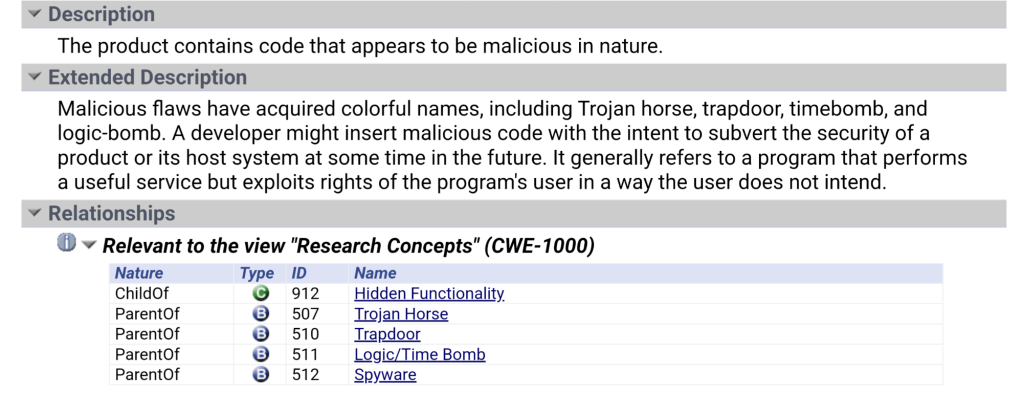
Open Source software is used by so many people, that it has become the target for a more sophisticated attacker. One that is so pernicious, it is known, in the Common Weakness and Exposure chart as CWE-506.
Let’s face it, over the last few decades, as the world was being eaten by software* we became too reliant on other people’s work. We ‘trusted’ what others were doing and relied too much on ‘good people doing great things’ so we could focus more on what we wanted.

The strength of open source (where so many eyes would review the code instead of just a handful of coders in a cave), makes us dependent on those same coders so if they don’t catch the malicious additions, who will?

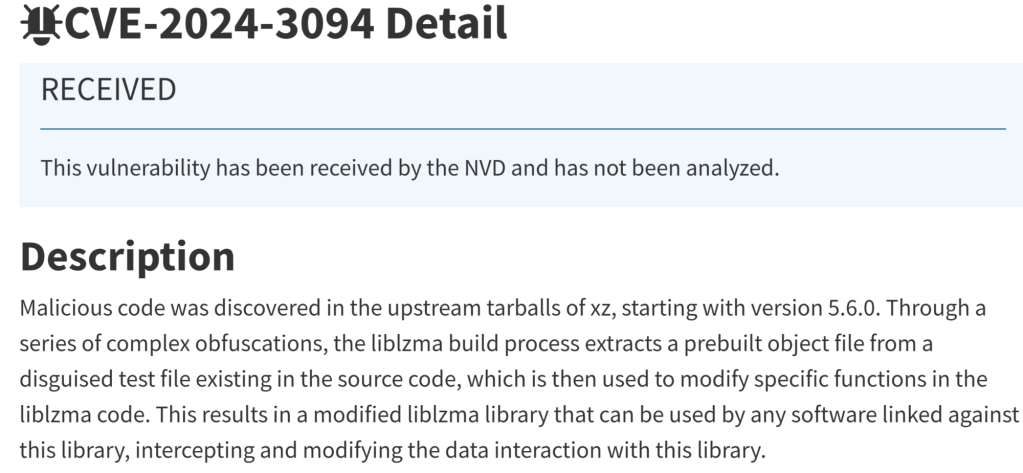
Luckily, in such a short time, a few posts by a couple of curious sysadmins on Thursday, managed to catch this ‘feature’ being added to the source, which quickly produced this CVE (above) so patch your stuff before you too, become backdoored.

For my readers, I can only say that, if you use software in your business (that should be *all* of you), then you probably use open source so ‘Verify then Trust’ because this happens more often than you realize. Invest in your Security program which should include a threat analysis channel. We are at War with the hacker community and they only need one to win!

Kubernetes and Certificates

March 21, 2024 Leave a comment

Kubernetes has become the defacto way to run software these days and many people are simply not aware of just how much it relies on cryptography. All the nodes use certificates for almost all the connections, the commands between them, Identity of services, and encryption at rest and in transit, and well… every part of the operating model. Functioning as its own Public Key Infrastructure, the security of the cluster is directly related to the safe and secure methods associated with all this key management. 

I wanted to raise the awareness for most of my readers, of many organizations use of Kubernetes and introduce the practices of Certificate Lifecycle Management as they apply to Kubernetes.

If you have used KinD (Kubernetes in Docker) before, you may notice that when you use the latest version of the kind-control-plane (from this image)

kindest/node     v1.29.2   09c50567d34e   4 weeks ago     956MB

You should notice that the Certificate Authority certificate is *still* being created to last 10 years.

docker exec -t kind-control-plane openssl x509 -startdate -enddate -noout -in /etc/kubernetes/pki/ca.crt

notBefore=Mar 12 17:27:26 2024 GMT

notAfter=Mar 10 17:32:26 2034 GMT

This helps to demonstrate that the primary Certificate authority that is used to stand up your kind cluster, has a lifecycle of 10 years. This seems overly permissive but for any root CA, it is still well under the acceptable limit. Why don’t we try to determine what our production GKE clusters are using by executing this command…

gcloud container clusters describe --zone <zone> <clustername> --project <projectname> --format="value(masterAuth.clusterCaCertificate)" | base64 --decode | openssl x509 -startdate -enddate -noout

When you execute this command on your tenant, what do you think we should see as the output? Would we see that you used your own root-CA to create an Intermediary CA for Google to use in your clusters? 

Ideally, a mature organization could be using a private CA (either external or now, with help as a Google service offering) to secure all certificates being created and verified inside each GKE cluster or nodes? (This might be a little too much to ask – we must walk before we learn to run)

What about letting Google, who is probably creating the cluster for you, create the Kubernetes Root CA and perhaps they would be following the best practice for root certificates by limiting it to 15 years? (Note: Google is *also* proposing a maximum term limit of 7 years for any publicly accessible root CA certificate https://www.chromium.org/Home/chromium-security/root-ca-policy/moving-forward-together/).  

Well, sadly, they continue to create the default term for their GKE Kubernetes clusters of…

notBefore=Mar 17 15:43:17 2022 GMT

notAfter=Mar  9 16:43:17 2052 GMT

30 years!

So now that we know that all certificates, for *any* purpose, within your GKE clusters, (at least this one) will be using a default lifetime of 30 years, you may be asking, is there anything we can do about that? I mean, what if the key becomes compromised, we should trust ANY activity, no service mesh, no identity, not even any nodes trying to communicate with the etcd (Kubernetes database) …. well surprisingly…. YES you can – you can rotate them yourself.

In this reference from the GKE help pages, we learn that we can perform a credential rotation as a way to mitigate the loss or compromise of your root CA keys! Great, but how hard is it?

gcloud container clusters update CLUSTER_NAME --region REGION_NAME --start-credential-rotation

gcloud container clusters upgrade CLUSTER_NAME --location=LOCATION --cluster-version=VERSION

You can use the same version of each cluster to force each node to request and use the newly created certificates that will be signed by the new Kubernetes root CA certificate. Once you are sure that all your nodes have been rotated and are using new credentials, you can complete the synchronization.

gcloud container clusters update CLUSTER_NAME --region REGION_NAME --complete-credential-rotation

So why don’t more organizations do this if the process is so easy to recover? Well, if you are deploying your clusters using defaults, you probably aren’t aware of this little fact. Security people have learned that it is better to be safe than to be sorry. Mature organizations become aware of these gotchas early on in their usage of Kubernetes (over 10 years now) and first learn how to correct bad outcomes. Later, they learn how to avoid these bad outcomes by managing all parts of the Kubernetes platform to help assure it.

Kubernetes *may* be the greatest invention since Virtualization, but with great power comes great responsibility. Don’t let an old hacker (like me) get the better of your organization!

Certificate Management may be hard, but you don’t have much choice any longer.

March 17, 2024 Leave a comment

Ever since the 1990s when Netscape₁ first introduced “Secure Sockets”, we have turned this thing called “The Internet” into an ecommerce engine worth over 3 trillion USD today. Statistics show that its growth is expected to top 5 trillion USD by 2029₂. Efforts to secure the Internet have been going on for three decades since then so why should be alarmed now? Well, it involves two of the most popular subjects in our modern era, Artificial Intelligence and Quantum Computing.

AI has proven to be highly effective at finding defects in software₃, something that humans continue to create and Quantum Computers will speed up computational power by a factor of 10x. Think of a hacker who never sleeps, has no preconceived notions about ‘if’ something can be accomplished, and just sets itself on a target of guessing your password or even breaking your encryption keys for your secure session with your bank? Is there any doubt that it will succeed…eventually, now that it is 10x faster? Does this sound like a George Orwell book, well it should, that time has arrived!

Traditional certificates relied on factorization of prime numbers. That is just a fancy way of saying 3 times 5 equals 15 (although this is an oversimplification). When you use factors that are thousands of digits long, computers were needed to solve these equations and reversing those equations would take years or even centuries. Now enter the Quantum computer that performs these calculations at dizzying speeds, and you are no longer safe. The only answer to help treat those risks is to replace those equations more often that one or twice every few years.

The scope of the problem becomes apparent when you see how prevalent traditional certificates are in our electronic world. Major use cases are not just limited to SSL/TLS certificates to protect your ecommerce or banking sites. They are used to provide integrity verification used in encryption for proof of ownership or tampering. They are also used for Identity (like secure shell or tokens) and systems that rely on trust. With AI and quantum wildly in use today, these systems are at risk if you do not replace these on a regular basis.

Google wants to shorten the lifecycle of certificates₄, to help manage the risk associated with SSL/TLs certificate usage on the Internet. By replacing the secrets more often, it makes it harder to guess them. Let’s Encrypt has be successful since the last decade, at generating 90-day certificates. There are many client implementations₅ that support the ACME standard that helps accomplish this.

This begs the question, “How do we manage hundreds of thousands of certificates at speeds that would take an army to accomplish?”

Automation is the key! Maybe you can ask your friendly AI prompt to help you accomplish this before someone uses it to crack your password and empty your bank account? 😊

Build/Maintain your own golden container base images

August 3, 2022 Leave a comment

Containers have become essential in the optimization of software delivery these days for any business. They can support the principals of least privilege and least access by removing most of the attack surface associated with exposing services for public consumption. They are the smallest unit that make up the 4Cs’ (CNCF uses this term to describe Cloud, Cluster, Container and Code) and have become an important part of Kubernetes management. Stripping away the complexity and isolation benefits makes them portable and it almost seems as though they have no downside right? Containers (and Kubernetes) are ephemeral and support the idea of a fully automated workload but we don’t patch them like we used to. So how do we ensure that the inevitable vulnerabilities that arise (daily if not weekly) can also be mitigated or even remediated? You start over (and over) again and again by using the ‘latest and greatest’ base images. To understand this process, we need to compare the strategy of traditional software deployment strategies and see how they differ.

First there was the base OS build where we deployed a operation System and struggled to keep it updated. We applied patches to the OS to replace any software components that needed to be replaced. Many organizations struggled with patching cadence when the fleet of systems grew to large to manage. The speed of patching needed to increase as more and more vulnerabilities were found which presented a challenge for larger organizations.

Containers start with a very small base image to provide some of the libraries that are necessary for the code that was deployed with the image. Developers need to actively minimize the components that are necessary for some core capabilities (like openssl for https, glibc for os file and device options, etc.) Failure to minimize the base image used can results in adding more and more of the libraries needed rather than relying on the benefits of a shared kernel. Best practices require the understanding of the OS being used so that the image size can be smaller and the attack surface can be reduced. This results in less vulnerabilities introduced at the container level which can result in a longer runtime using that container image.

In support of this model, it is suggested that we consider how to maintain an approved (secure) base image for any container development so our deployment strategy can make use of secure (known NOT vulnerable) images to start from. The OS manufacturers are always releasing patched versions of their base image file-systems complete with the updated components. If we consider how to turn those updated base OS images into approved secure base images, the benefits provided can increase our productivity while reducing our attack surfaces.

The process proposed here can help us obtain and build base images that have a unique hash associated with them. Since container filesystems (ausfs, overlay) can be fingerprinted, we can validate the base image hash through the entire release life-cycle. This provides an added layer of detection against rogue container use and can provide an early warning detection mechanism for both development as well as operations teams. Detecting who is using a known vulnerable base image can provide notification to be sent to application owners until those vulnerable images are removed from all of our systems.

Let me show you how this can be accomplished for any of the base images that should be approved for consumption. We start by using the ‘current build’ for any of the base OS images that we want to use. (Remember, whether your nodes run RedHat, Debian, Ubuntu, Oracle, etc. to gain the best performance and to make the best use of resources, your choice of base OS should match your node runtime version. Lets grab the latest version of the Jammy base OS for amd64 – I will use podman to build my OCI compatible image but we can also do this with docker.)

Step 1 (we should repeat this whenever there is a major change in this release. The vendor will update this daily)

root : podman import http://cdimage.ubuntu.com/ubuntu-base/jammy/daily/current/jammy-base-amd64.tar.gz jsi-jammy-08-22

Downloading from "http://cdimage.ubuntu.com/ubuntu-base/jammy/daily/current/jammy-base-amd64.tar.gz"
Getting image source signatures
Copying blob 911f3e234304 skipped: already exists
Copying config 4d667a55fb done
Writing manifest to image destination
Storing signatures
sha256:4d667a55fbdefddff7428b71ece752f7ccb7e881e4046ebf6e962d33ad4565cf

(Notice the hash of the base container image above. MY image was already downloaded)

Step 2 (we save the image archive now as a container to be tested)

root : podman save -o jsi-08-22.tar –format oci-archive jsi-jammy-08-22

Copying blob bb2923fbc64c done
Copying config 4d667a55fb done
Writing manifest to image destination
Storing signatures

(we are using the name of the image and the date [mm/yy] to identify it. You may also use image tags but it is best practice to use unique naming)

Step 3 (lets save some space and compress it)

root : gzip -9 jsi-jammy-08-22.tar – ( results in the image named jsi-jammy-08-22.tar.gz)

Final step is to run it though a security scan to ensure there are no high or critical vulnerabilities contained in this base image.

C:\image>snyk container test oci-archive:jsi-jammy-08-22.tar.gz

Testing oci-archive:jsi-jammy-08-22.tar.gz…

✗ Low severity vulnerability found in tar
Description: NULL Pointer Dereference
  Info: https://snyk.io/vuln/SNYK-UBUNTU2204-TAR-2791257
Introduced through: meta-common-packages@meta
From: meta-common-packages@meta > tar@1.34+dfsg-1build3

✗ Low severity vulnerability found in shadow/passwd
Description: Time-of-check Time-of-use (TOCTOU)
  Info: https://snyk.io/vuln/SNYK-UBUNTU2204-SHADOW-2801886
Introduced through: shadow/passwd@1:4.8.1-2ubuntu2, adduser@3.118ubuntu5, shadow/login@1:4.8.1-2ubuntu2
From: shadow/passwd@1:4.8.1-2ubuntu2
From: adduser@3.118ubuntu5 > shadow/passwd@1:4.8.1-2ubuntu2
From: shadow/login@1:4.8.1-2ubuntu2

✗ Low severity vulnerability found in pcre3/libpcre3
Description: Uncontrolled Recursion
  Info: https://snyk.io/vuln/SNYK-UBUNTU2204-PCRE3-2799820
Introduced through: pcre3/libpcre3@2:8.39-13ubuntu0.22.04.1, grep@3.7-1build1
From: pcre3/libpcre3@2:8.39-13ubuntu0.22.04.1
From: grep@3.7-1build1 > pcre3/libpcre3@2:8.39-13ubuntu0.22.04.1

✗ Low severity vulnerability found in pcre2/libpcre2-8-0
Description: Out-of-bounds Read
  Info: https://snyk.io/vuln/SNYK-UBUNTU2204-PCRE2-2810786
Introduced through: meta-common-packages@meta
From: meta-common-packages@meta > pcre2/libpcre2-8-0@10.39-3build1

✗ Low severity vulnerability found in pcre2/libpcre2-8-0
Description: Out-of-bounds Read
  Info: https://snyk.io/vuln/SNYK-UBUNTU2204-PCRE2-2810797
Introduced through: meta-common-packages@meta
From: meta-common-packages@meta > pcre2/libpcre2-8-0@10.39-3build1

✗ Low severity vulnerability found in ncurses/libtinfo6
Description: Out-of-bounds Read
  Info: https://snyk.io/vuln/SNYK-UBUNTU2204-NCURSES-2801048
Introduced through: ncurses/libtinfo6@6.3-2, bash@5.1-6ubuntu1, ncurses/libncurses6@6.3-2, ncurses/libncursesw6@6.3-2, ncurses/ncurses-bin@6.3-2, procps@2:3.3.17-6ubuntu2, util-linux@2.37.2-4ubuntu3, ncurses/ncurses-base@6.3-2
From: ncurses/libtinfo6@6.3-2
From: bash@5.1-6ubuntu1 > ncurses/libtinfo6@6.3-2
From: ncurses/libncurses6@6.3-2 > ncurses/libtinfo6@6.3-2
and 10 more...

✗ Low severity vulnerability found in krb5/libkrb5support0
Description: Integer Overflow or Wraparound
  Info: https://snyk.io/vuln/SNYK-UBUNTU2204-KRB5-2797765
Introduced through: krb5/libkrb5support0@1.19.2-2, adduser@3.118ubuntu5, krb5/libk5crypto3@1.19.2-2, krb5/libkrb5-3@1.19.2-2, krb5/libgssapi-krb5-2@1.19.2-2
From: krb5/libkrb5support0@1.19.2-2
From: adduser@3.118ubuntu5 > shadow/passwd@1:4.8.1-2ubuntu2 > pam/libpam-modules@1.4.0-11ubuntu2 > libnsl/libnsl2@1.3.0-2build2 > libtirpc/libtirpc3@1.3.2-2ubuntu0.1 > krb5/libgssapi-krb5-2@1.19.2-2 > krb5/libkrb5support0@1.19.2-2
From: adduser@3.118ubuntu5 > shadow/passwd@1:4.8.1-2ubuntu2 > pam/libpam-modules@1.4.0-11ubuntu2 > libnsl/libnsl2@1.3.0-2build2 > libtirpc/libtirpc3@1.3.2-2ubuntu0.1 > krb5/libgssapi-krb5-2@1.19.2-2 > krb5/libk5crypto3@1.19.2-2 > krb5/libkrb5support0@1.19.2-2
and 8 more...

✗ Low severity vulnerability found in gmp/libgmp10
Description: Integer Overflow or Wraparound
  Info: https://snyk.io/vuln/SNYK-UBUNTU2204-GMP-2775169
Introduced through: gmp/libgmp10@2:6.2.1+dfsg-3ubuntu1, coreutils@8.32-4.1ubuntu1, apt@2.4.6
From: gmp/libgmp10@2:6.2.1+dfsg-3ubuntu1
From: coreutils@8.32-4.1ubuntu1 > gmp/libgmp10@2:6.2.1+dfsg-3ubuntu1
From: apt@2.4.6 > gnutls28/libgnutls30@3.7.3-4ubuntu1 > gmp/libgmp10@2:6.2.1+dfsg-3ubuntu1
and 1 more...

✗ Low severity vulnerability found in glibc/libc-bin
Description: Allocation of Resources Without Limits or Throttling
  Info: https://snyk.io/vuln/SNYK-UBUNTU2204-GLIBC-2801292
Introduced through: glibc/libc-bin@2.35-0ubuntu3.1, meta-common-packages@meta
From: glibc/libc-bin@2.35-0ubuntu3.1
From: meta-common-packages@meta > glibc/libc6@2.35-0ubuntu3.1

✗ Low severity vulnerability found in coreutils
Description: Improper Input Validation
  Info: https://snyk.io/vuln/SNYK-UBUNTU2204-COREUTILS-2801226
Introduced through: coreutils@8.32-4.1ubuntu1
From: coreutils@8.32-4.1ubuntu1

✗ Medium severity vulnerability found in perl/perl-base
Description: Improper Verification of Cryptographic Signature
  Info: https://snyk.io/vuln/SNYK-UBUNTU2204-PERL-278908
Introduced through: meta-common-packages@meta
From: meta-common-packages@meta > perl/perl-base@5.34.0-3ubuntu1
--------------------------------------------------------
Tested 102 dependencies for known issues, found 11 issues.

——————————————————————————-

(Look Ma, no high or critical findings!)

Now we have a base OS image ready to be used with any new/existing container build process. Best practices include the ability to digitally sign these images so that build pipelines can verify that any images being included are tested and approved. We can remove the previous version of the base OS image and provide a notice to current/future users that vulnerabilities have been found in the previous version. Dev teams can bump the version in any code they have and begin to test if there are any breaking changes that would require refactoring. Even if there is no change in the code, they must release their containers using these new base OS images to mitigate any vulnerabilities that are introduced.

Categories: security, Work related Tags: ,

After the breach…

July 26, 2022 Leave a comment

Accidents happen and in the security field, they are usually called an ‘0-day’.

There are (at least) three questions you may be asked by your board, about your AppSec program…

  • Was all the software tested using all of our controls & capabilities that were applicable?
  • Did all the findings that were produced measure below our acceptable risk ratings?
  • Were any/all of the vulnerabilities being fixed according to our accepted remediation timelines?

Lets unpack that for everyone in an attempt to understand the motivations of some of our brightest ‘captains’. (If I was a board member…)

Misinformation – Does this event signal a lack of efficacy of our overall Appsec program? Do the controls work according to known practices? Perhaps, this is an anomaly, an edge case that now requires additional investment? What guarantees do we have that any correction strategy will be effective? If changes are warranted, which part should we focus on, People, Process or Technology?

Jeff says – changing the program can take a large investment for any/all of these. Get back to the basics and start with some metrics to see if you have effective coverage first. Prioritize making policy/configuration visible for each implementation of your security tools and aim for all of your results in one tool.

Liability – Is our security assessment program effective enough? Does this blind spot show us the inability to understand/avoid these threats at scale? Does this event indicate a systemic failure to detect/prevent this type of threat in the future?

Jeff says – Push results from Pentesting/Red Team/Security Ops back into the threat model and show if/how any improvement can be effective. Moving at the speed of DevOps means running more tests, more often, and correlating the findings to show value through velocity by catching and fixing them quickly.

Profit and Loss – Do we have a software quality problem that may require us to consider an alternative resource pool? If digitization is increasing in cost due to loss, maybe we need to improve our control capabilities to detect/prevent bad software from reaching production? Maybe we should take additional steps to ensure we have the right development teams to avoid mistakes?

Jeff says – to stop the bleeding, you might consider a different source of secure code? You might also consider an adjustment to your secure training programs? Maybe your security analysts are having their own quality issues? Consider raising the threshold of approved tools to be considered? Broker communication for your dev teams to take on more of the security responsibility.

For any leadership who is dealing with CyberSecurity these days, these are all very good questions. Security is Hard, Application Security, Cloud Security, Data Security – they are ALL hard individually so how does any one person/team understand them entirely?

I began to ask myself that question almost a decade ago during my mobile penetration testing period. When Facebook had created React which involved more than one software language in the same project. I found a cross site scripting flaw in the mobile client during testing which I felt pretty confident was NOT a false positive. I decided to check the static code findings to see if this could be correlated. (We can save the rest of that story for another blog post).

A light went off in my head, ‘correlation between two or more security tools in a single pane of glass’. What an idea – you need something that can pull in all of the datasets (finding reports) and provide some deduplication (so we don’t give dev teams multiple findings from multiple tools), just the fact that we are confident of the viability of the finding. I investigated some of the tool vendors and worked with them for a few years while the capability began to mature in the industry.

Today, Gartner calls this space Application Security Orchestration and Correlation, a contraction of ‘security orchestration’ (where you apply policy as code) and correlating, deduping the results. When done successfully, it also provides a single pane of glass for the operations team or any other orchestration or reporting software in use in your org. Think of it as the one endpoint with all the answers; a way to abstract away the API schema and various life-cycle changes that are associated with new and existing tool-sets.

Whether you wish to interconnect all of your existing orchestration tooling for your pipelines & other infrastructure or perhaps you want to build out your security governance capabilities by conducting all of your own security testing, ASOC tools are capable of providing security at the speed of DevOps.

There really is no other way to accomplish it at scale!

Categories: security, Work related Tags: ,

Infosec not your job but your responsibility? How to be smarter than the average bear

July 25, 2022 Leave a comment

Want to measure how beneficial it is for your software development teams to learn to think more like an adversary? Just look at the first 20 years of use against the last 10-20?

https://www.theregister.com/2022/07/25/infosec_not_your_job/

Cloud Vulnerabilities & Security Issues Database

July 22, 2022 Leave a comment

For those of us who thought the rising list of new CVEs was bad enough, now comes a new list of cloud platform relayed vulnerabilities that only your choice of CSP is responsible to fix.

Time to update your threat models folks!

https://www.cloudvulndb.org/

Categories: security Tags: ,

SLSA • Supply-chain Levels for Software Artifacts

Oh thank God I am not the only one who sees the next techopolus (O-day apocalypse) as we all adopt kubernetes as the orchestration platform and we forget about *where* those container images come from… http://slsa.dev/

Categories: security Tags: , , ,